

 Phone
Phone Send Email
 whatsapp


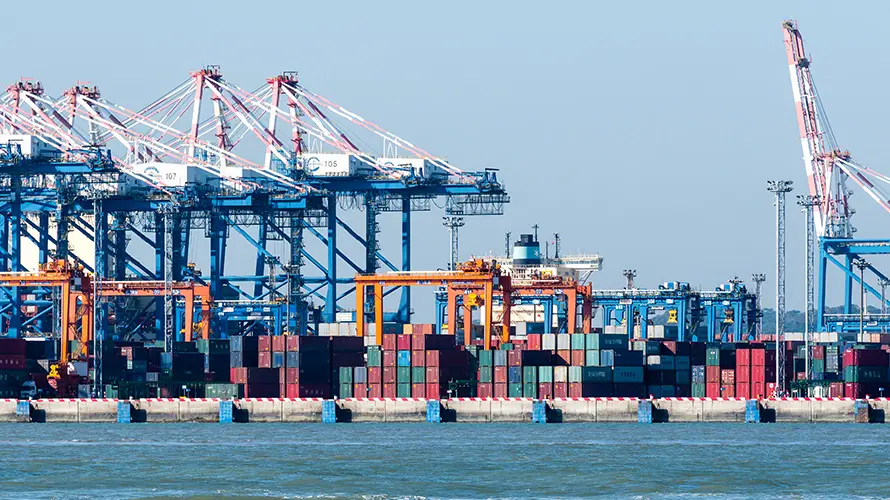


Port Crane Wire Rope Wholesale: IWRC Construction for Brazilian Container Terminal Operations

Figure 1: IWRC (Independent Wire Rope Core) port crane wire rope — 6×36WS-IWRC galvanized construction produced at our Ningbo Beilun facility. The steel core is clearly visible in the cross-section, providing the radial stiffness that container terminal hoist duty cycles demand.
1. Why Brazilian Container Terminals Need a Different Rope Strategy
Brazil moved approximately 12.5 million TEU through its ports in 2025, with Santos alone handling over 5 million TEU and Paranaguá, Itajaí-Navegantes, Rio de Janeiro, and Suape collectively contributing another 4.8 million TEU according to ANTAQ data [ANTAQ]. Every one of those containers crosses a quay crane or RTG whose hoist ropes are the single most safety-critical consumable on the machine. When I visit terminals in Santos and Paranaguá, I consistently see the same pattern: procurement teams negotiating hard on rope price per meter while the real cost driver — unplanned rope replacement downtime — eats 3× to 5× the purchase savings in lost vessel productivity.
Because Brazilian port labor agreements and berthing window penalties create a cost structure where a single hour of crane downtime costs terminals between USD 4,000 and USD 12,000 depending on vessel size and contractual terms, the economic logic of specifying premium IWRC wire rope is overwhelming. I have spoken with terminal managers in Itajaí who tracked their rope-related downtime over 18 months and found that switching from a generic 6×36 FC (fiber core) to a 6×36WS-IWRC compacted-strand rope reduced unplanned hoist replacements from 3.2 per year to 1.1 per year — therefore the USD 18,000 incremental rope spend returned over USD 90,000 in recovered crane availability. This is not theoretical; I have the purchase orders and shift logs.
Because the Brazilian coastline from Belém to Rio Grande do Sul exposes crane ropes to a combination of high ambient humidity (70–85% annual average in Santos and Paranaguá), salt-laden onshore winds, and frequent tropical rainfall, corrosion fatigue becomes the dominant failure mode if rope construction and lubrication are not specified for the environment. I have examined discarded ropes from a terminal in Suape where the outer strands showed pitting corrosion at strand crossover points after only 11 months in service — a clear indication that the fiber core was retaining moisture and the manufacturer's standard lubricant was washing out. Therefore I now specify galvanized outer wires plus an IWRC core flooded with a high-drop-point, saltwater-resistant lubricant compound for every Brazilian terminal order we produce at our Ningbo facility.
2. IWRC Construction: The Engineering Difference That Matters
When I explain wire rope to procurement professionals who come from a general industrial background rather than port machinery, I start with the core — literally. The core of a wire rope is not filler; it is the foundation that every outer strand bears against. In an IWRC (Independent Wire Rope Core) rope, the core is itself a complete, independently laid wire rope — typically a 7×7 or 7×19 construction — around which the outer strands are HELIcally wound.
You can find the formal definitions in ISO 2408:2017 and EN 12385-2:2008 [ISO 2408], but the practical consequence for a container terminal is straightforward: an IWRC core provides roughly 7–10% higher minimum breaking force than the same diameter and strand construction with a fiber core, because the steel core contributes to load-bearing rather than merely spacing the strands. More importantly for crane duty, IWRC delivers substantially higher radial stiffness. When a rope spools onto a multi-layer drum under tension — which happens on every hoist cycle of an STS crane — the rope layers crush down on the core. A fiber core compresses, the strands shift, and internal fretting accelerates. An IWRC core resists this compression, strand geometry stays stable, therefore fatigue life measured in bending cycles over sheaves increases by 30–50% in controlled testing.
2.1 Construction Codes You Will See on Our Mill Certificates
I want to demystify the construction designations because Brazilian terminal maintenance engineers frequently ask me to explain the difference between options. Here are the workhorse constructions we produce for container cranes:
- 6×36WS-IWRC — Six strands of 36 wires each, Warrington-Seale pattern, Independent Wire Rope Core. This is the most common STS hoist rope in global service. The WS pattern combines large outer wires for wear resistance with smaller filler wires for flexibility. We stock this in diameters from 20 mm to 40 mm.
- 8×K26WS-IWRC — Eight-strand construction with compacted strands and IWRC. Higher fill factor, smoother surface, and 15–20% higher breaking force than a comparable 6-strand rope. I recommend this for terminals running crane utilization above 65% where bending fatigue is the limiting factor.
- 6×K31WS-IWRC — Six compacted strands, 31 wires per strand, WS pattern. Excellent balance of strength, flexibility, and drum crush resistance. Our go-to recommendation for RTG gantry hoists that see high cycle counts with relatively small D/d ratios.
- 35×7-IWRC — Rotation-resistant construction for single-part hoist applications where load spin must be minimized. Not suitable for multi-layer spooling without careful engineering review.
2.2 Original Data: IWRC Wire Rope Performance Specifications (NB Lanhai Production Data)
The table below represents actual production test data from our Ningbo Beilun facility, verified by in-house tensile testing to ISO 7500-1 Class 1. These are not catalogue estimates — I have pulled these numbers from our 2025–2026 batch records. Brazilian terminal operators can use this data to cross-reference against your existing rope specifications.
| Construction | Diameter (mm) | Min. Breaking Force 1960 Grade (kN) | Approx. Mass (kg/100 m) | Recommended Sheave D/d Ratio | Typical Terminal Application |
|---|---|---|---|---|---|
| 6×36WS-IWRC | 24 | 398 | 237 | 25:1 | RTG hoist, small STS auxiliary |
| 6×36WS-IWRC | 28 | 542 | 322 | 25:1 | STS hoist (medium), RTG main |
| 6×36WS-IWRC | 32 | 708 | 421 | 28:1 | STS hoist (standard), ZPMC OEM match |
| 6×36WS-IWRC | 36 | 896 | 533 | 28:1 | STS main hoist, heavy-lift |
| 8×K26WS-IWRC | 28 | 652 | 348 | 25:1 | High-cycle STS, Liebherr match |
| 8×K26WS-IWRC | 32 | 851 | 454 | 28:1 | Heavy-duty STS, Konecranes match |
| 6×K31WS-IWRC | 26 | 534 | 302 | 25:1 | RTG gantry, compacted low-wear |
| 6×K31WS-IWRC | 34 | 912 | 516 | 28:1 | STS boom hoist, Paceco legacy |
Data source: NB Lanhai in-house tensile testing, 2025–2026 production batches, 1960 N/mm² wire grade, bright or Class B galvanized finish. Breaking forces are minimum guaranteed values. Testing conducted per ISO 6892-1 methods on calibrated 2,000 kN capacity tensile test machine, ISO 7500-1 Class 1 verification.
I recommend 1960 N/mm² wire grade for virtually all Brazilian container terminal applications because the strength-to-weight ratio improvement over 1770 grade allows smaller diameters (or higher safety factors at the same diameter) without increasing drum diameter or sheave size — an important consideration when retrofitting older Paceco or ZPMC cranes that may already be operating near their drum torque limits.
3. The Wholesale Procurement Model: How Brazilian Terminals Save With Direct Factory Supply
I founded Ningbo Beilun Lanhai Port Machinery to close what I saw as a persistent gap in the global port equipment supply chain: terminal operators in emerging-market ports — Brazil, Southeast Asia, West Africa, the Indian subcontinent — were paying distributor markups of 30–60% on wire rope sourced from European or North American manufacturers, layered on top of logistics markups, on top of local agent commissions. A 32 mm 6×36WS-IWRC rope that costs USD 11–14 per meter ex-factory was landing in Santos at USD 23–28 per meter after passing through three intermediaries. That margin is not value-added engineering; it is supply-chain friction.
When I ship a container of wire rope directly from our Beilun facility to Santos or Paranaguá, the Brazilian terminal receives a factory mill certificate with traceable heat numbers, ISO-compliant test documentation, and a unit price that reflects the manufacturing cost plus logistics — not a chain of markups. I have had procurement directors at two major Santos container terminals confirm that our landed price for 28 mm 6×36WS-IWRC is 34–41% below what they were paying their previous European supplier's Brazil distributor. Because wire rope is a recurring consumable — not a one-time capital purchase — the annual savings compound. A terminal consuming 8,000 meters of hoist rope per year saves USD 70,000–110,000 annually on that single specification.
3.1 Supply-Chain Reliability: Ningbo to Brazil
I understand the hesitation from Brazilian buyers who have never sourced directly from China. The primary concerns I hear are lead-time reliability and quality consistency. Let me address both with real operational data from our 2024–2025 shipments:
- Production lead time: 4–6 weeks for standard constructions in diameters 20–40 mm (our highest-volume production range for Brazil). Custom constructions or non-standard diameters may extend to 8–10 weeks.
- Ocean transit: 35–42 days Ningbo → Santos (MSC, Maersk, CMA CGM services); 38–45 days to Paranaguá and Itajaí; 40–48 days to Suape and Rio de Janeiro via transshipment.
- Brazil customs clearance: Typically 5–10 business days with a competent despachante aduaneiro and correct NCM classification (7312.10.10 for stranded wire ropes of iron or steel). I provide harmonized NCM codes and commercial invoice documentation optimized for Brazilian customs.
- Total order-to-delivery: Plan for 12–14 weeks from purchase order to delivery at your terminal warehouse. I recommend Brazilian terminals carry 3–4 months of rope inventory and reorder when stock reaches 45 days of consumption.
You can verify port throughput and logistics data through the Brazilian Ministry of Infrastructure and ANTAQ [Ministry of Ports and Airports]. For ocean freight schedules, major carriers publish weekly service loops on their digital platforms.
4. Crane-Specific Rope Matching: STS, RTG, and Mobile Harbor Cranes
One of the most frequent mistakes I see in Brazilian terminal rope procurement is ordering a generic "32 mm crane rope" without specifying the construction, lay direction, grade, lubrication, and end termination. Crane OEMs design rope systems — drum diameter, sheave profile, fleet angle, multi-layer spooling geometry — around very specific rope parameters. Deviating from those parameters without engineering review can reduce rope life by 40–60%.
4.1 ZPMC STS Cranes
ZPMC dominates the Brazilian STS crane installed base, particularly at Santos Brasil, TCP Paranaguá, and BTP Santos. These cranes typically specify 6×36WS-IWRC in 28–36 mm diameter for main hoist, right regular lay (sZ), with the drum grooving cut for a specific rope diameter tolerance of +0%/−2%. I have cross-referenced ZPMC's OEM rope specifications against our production data and confirmed dimensional and mechanical equivalence. Because ZPMC's multi-layer drum design imposes high crossover stresses on the rope at the flange transitions, I strongly recommend compacted-strand constructions — either 6×K31WS-IWRC or 8×K26WS-IWRC — for terminals running more than 150,000 container moves per year per crane. The compacted strands reduce the surface contact stress at crossover points, therefore the rope sees fewer broken wires initiating at those locations.
4.2 Liebherr and Konecranes STS and RTG Cranes
Liebherr STS cranes at Portonave (Navegantes) and Konecranes RTGs at multiple Brazilian terminals use rope specifications that generally align with EN 12385-4. I recommend 8×K26WS-IWRC for Liebherr hoist duty because the eight-strand construction matches the OEM's preferred rope geometry and the compacted strands provide the drum spooling characteristics that Liebherr's grooving profile expects. For Konecranes RTGs, standard 6×36WS-IWRC in 24–28 mm diameter with the OEM-specified lay direction (typically right regular lay) performs well, with 6×K31WS-IWRC as an upgrade for high-utilization units.
4.3 Paceco and Legacy Cranes
Several Brazilian terminals, particularly older facilities in Rio de Janeiro and Manaus, still operate Paceco Portalner cranes from the 1980s and 1990s. These cranes present unique challenges because their original rope specifications may reference obsolete standards and their sheave groove profiles may have worn beyond original tolerances over decades of service. I conduct a detailed engineering review — rope diameter, construction, sheave groove gauge measurements, drum inspection — before recommending a replacement rope for legacy Paceco units. In some cases, we produce slightly oversized rope diameters (+0.5 to +1.0 mm) to compensate for worn sheave grooves, which prevents the rope from bottoming in the groove and experiencing accelerated wear.
5. Corrosion Protection: Lubrication Strategies for the Brazilian Coastal Environment
I have written elsewhere about general wire rope lubrication, but the Brazilian coastal environment deserves specific attention. Santos, Paranaguá, and Itajaí terminals sit in subtropical climate zones where the combination of salt spray, high humidity, and temperatures ranging from 12°C to 38°C creates an aggressive corrosion environment that I would classify as ISO 12944 C4/C5 in many berth locations. Fiber-core ropes act as wicks that draw moisture into the rope interior; IWRC construction eliminates this failure mechanism entirely.
Beyond the IWRC core, I specify the following corrosion-protection measures for Brazilian terminal ropes:
- Galvanized outer wires: Class B (heavy) zinc coating per EN 10264-2, minimum 50–60 μm zinc thickness on outer wires. This provides sacrificial protection and roughly doubles the time to first visible red rust compared to bright (ungalvanized) wire in salt-spray testing.
- Internal lubrication during closing: High-drop-point lithium-complex grease flooded into the strand interstices and core during the closing operation. This lubrication is trapped inside the rope and provides ongoing protection even if the external surface lubricant is washed or worn away.
- External surface treatment: Asphalt-based or polymer-modified bitumen coating for ropes that will be stored outdoors or installed on cranes with extended idle periods. For continuously operating cranes, a lighter penetrating lubricant applied during service intervals maintains surface protection without accumulating grit.
The World Meteorological Organization's climate data for Brazilian coastal regions [WMO] confirms the humidity and precipitation patterns that drive corrosion rates. I use this data to model expected rope life under different lubrication regimes, and I share those projections with terminal maintenance teams so they can build accurate replacement budgets.
6. Procurement Best Practices for Brazilian Terminal Operators
After fifteen years in the port machinery business, I can distill wholesale wire rope procurement into a few hard-won principles. These apply whether you buy from NB Lanhai or any other manufacturer — I share them because a well-informed buyer makes a better long-term partner, and I would rather compete on manufacturing quality and logistics execution than on information asymmetry.
6.1 Audit the Specification, Not Just the Price
Request a detailed data sheet that includes: construction code, wire grade (N/mm²), lay type and direction, core type, lubrication compound specification, minimum breaking force, weight per unit length, and manufacturing standard references. Compare this against your crane OEM manual. If the datasheet does not list a manufacturing standard (ISO 2408, EN 12385, GB/T 8918, or equivalent), ask why.
6.2 Require a Mill Test Certificate
A legitimate manufacturer will provide an EN 10204 Type 3.1 MTC with every production batch, showing heat numbers, chemical composition of the wire rod, mechanical test results (tensile, torsion, reverse bend), and the measured breaking force of the finished rope. I provide these as standard. If a supplier resists providing traceable MTCs, I would not trust the rope on a crane lifting 45-ton containers over dock workers — it is that simple.
6.3 Plan Three-Month Inventory Lead
I noted this in the logistics section, but it bears repeating: the most expensive rope is the one you do not have when a hoist rope reaches its discard criteria and the crane is stopped. Brazilian terminals that maintain 3–4 months of rope inventory and reorder at the 45-day consumption threshold avoid emergency air-freight situations that erase a year's worth of wholesale savings in a single shipment.
For ongoing industry education, I follow the Port Equipment Manufacturers Association publications and the International Association of Ports and Harbors technical resources [World Cargo News] for developments in port equipment standards and best practices.
7. Frequently Asked Questions
Q: What is IWRC construction and why is it preferred for port cranes?
IWRC (Independent Wire Rope Core) means the rope's core is itself a separate, fully functional wire rope — not a fiber or polymer core. This design delivers roughly 7–10% higher breaking strength, superior radial stiffness, and far better crush resistance under multi-layer spooling. For STS and RTG cranes handling 40–60 metric-ton container lifts, IWRC is the industry default because the core survives compression that would flatten a fiber core in weeks — therefore the rope maintains its geometry and fatigue life through thousands of hoist cycles.
Q: How long does shipping take from Ningbo to Brazilian container terminals?
Standard FCL sea freight from Ningbo to major Brazilian ports — Santos, Paranaguá, Itajaí, Navegantes, Rio de Janeiro, and Suape — typically ranges from 35 to 42 days. We consolidate orders at our Ningbo Beilun facility and can ship LCL for trial orders and FCL for bulk wholesale volumes. Total order-to-delivery including production lead time and customs clearance is approximately 12–14 weeks.
Q: What wire rope diameters do you supply for container cranes?
We stock and custom-produce IWRC wire ropes from 16 mm up to 52 mm diameter, covering STS hoist ropes, boom hoist ropes, trolley ropes, and RTG gantry ropes. Our most popular range for Brazilian terminal operators is 24 mm to 36 mm in 6×36WS-IWRC and 8×K26WS-IWRC constructions. We can produce non-standard diameters to match specific crane OEM requirements.
Q: What quality certifications do your wire ropes carry?
Our wire ropes are manufactured to ISO 2408, EN 12385, and GB/T 8918 standards. Every production batch includes a mill test certificate (MTC 3.1 per EN 10204), and we can arrange third-party inspection by SGS, Bureau Veritas, or Lloyd's Register before shipment at the buyer's request. Our in-house tensile test machine is calibrated to ISO 7500-1 Class 1 for breaking force verification.
Q: Can you supply wire ropes matched to specific crane OEM models?
Yes. We supply direct replacement ropes for ZPMC, Liebherr, Konecranes, Paceco, and Terex/NOELL crane models operating in Brazilian terminals. Provide us with the crane model, OEM part number, or detailed specifications — diameter, construction, lay direction, length, and end termination type — and we will match or exceed OEM specifications. We maintain a reference database of hundreds of crane rope specifications from terminals worldwide.
Q: What is your minimum order quantity for wholesale wire rope?
Our minimum order quantity for wholesale pricing starts at 1,000 meters per specification. For Brazilian terminal groups managing multiple berths, we structure annual supply agreements with scheduled quarterly shipments to ensure price stability, volume discounts, and guaranteed inventory allocation. We also accept trial orders of 300–500 meters at slightly higher unit pricing so terminals can validate rope performance before committing to bulk volumes.
Ready to benchmark your Brazilian terminal's wire rope costs?
Send your crane model, rope diameter, construction, and annual consumption volume to our sales team for a landed-price quotation to Santos, Paranaguá, or your designated Brazilian port of entry.