

 Phone
Phone Send Email
 whatsapp


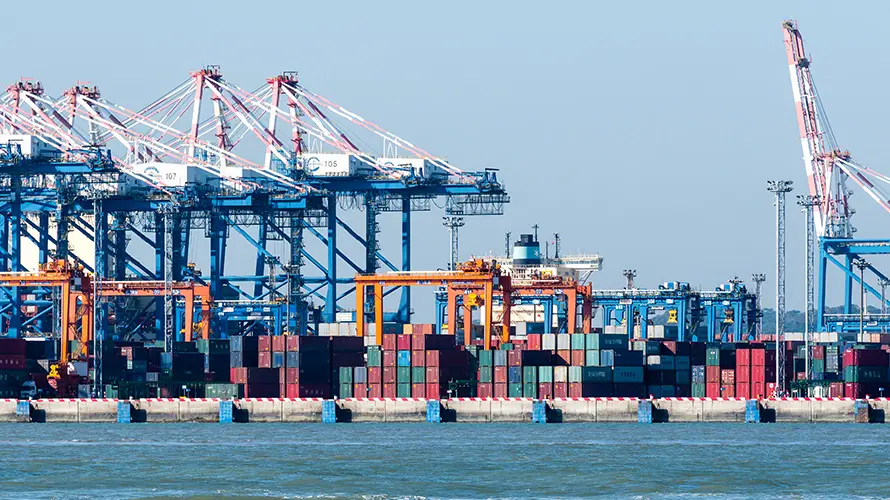


The Port of Rotterdam handles 467 million tonnes of cargo annually, making it Europe's largest and the world's 4th largest seaport (Port of Rotterdam Authority, Annual Report 2024). Within this massive logistics ecosystem, reach stackers — the heavy-lift container handling vehicles that stack containers five-high and move them between ships, trucks, and rail — are the workhorses. And at the hydraulic heart of every reach stacker is the hydraulic pump: for Kalmar equipment, the part number 923141.0092 has become one of the most commonly sought replacement components in European port maintenance operations.
This article examines how Rotterdam port operators source the Kalmar 923141.0092 hydraulic pump, the economics of OEM versus third-party procurement, CE compliance requirements, and how Ningbo Beilun Lan Hai Port Machinery — a specialized port machinery component supplier based in China's Zhejiang province — positions its Hydraulic Parts range for the European port equipment market.
Understanding the Kalmar 923141.0092 Hydraulic Pump
The part number 923141.0092 is a Kalmar-designated hydraulic pump used in specific reach stacker models within Kalmar's heavy-duty range. As an OEM part number, it represents a fixed-displacement hydraulic pump — typically a gear pump or axial piston pump depending on the specific reach stacker hydraulic circuit design — rated for the demanding pressure and flow requirements of reach stacker lifting and tilting operations.
Reach stacker hydraulic systems operate under some of the most demanding conditions in port equipment:
- Peak pressures of 250–320 bar during heavy lift operations (lifting 45-tonne container stacks at maximum reach)
- Continuous cycling — a busy Rotterdam reach stacker may perform 200–400 lift cycles per shift
- Wide temperature range — hydraulic fluid temperatures fluctuate from near-freezing in winter storage to 70–80°C during intensive summer operations
- Contaminated environment — salt air, container dust, and cargo residues create challenges for hydraulic seal integrity
The 923141.0092 pump must deliver reliable performance across all these conditions. When it fails, the cost calculus is stark: according to the Port of Rotterdam Authority's 2023 operational data, a single reach stacker hour of downtime costs between €800 and €2,000 depending on the cargo value being delayed and the substitution cost of standby equipment.
Reach Stacker Hydraulic System Maintenance Cycles
Rotterdam port operators typically maintain their reach stacker fleets on a preventive maintenance schedule that follows either hours-based or cycles-based triggers — whichever comes first. For the hydraulic system, including the main pump, the typical maintenance framework looks like this:
| Maintenance Action | Trigger | Notes |
|---|---|---|
| Hydraulic oil and filter replacement | Every 2,000 hours or 12 months | Oil analysis recommended at each change |
| Hydraulic pump inspection | Every 3,000 hours | Check flow output, pressure stability, noise |
| Hose and seal replacement | Every 4,000 hours or 2 years | Salt air accelerates rubber degradation |
| Hydraulic pump replacement | Every 8,000–12,000 hours | Or when flow output drops below 90% of rated |
| Full hydraulic system overhaul | Every 15,000 hours | Includes reservoir, heat exchangers, valves |
For a port operator running 30–50 reach stackers — not unusual for a large Rotterdam stevedoring company — this maintenance schedule translates into 3–6 pump replacements per year across the fleet. At Kalmar OEM list prices, that is a significant annual maintenance cost, which explains why the procurement conversation around the 923141.0092 pump is never just about the unit price.
OEM vs. Third-Party Sourcing: The Rotterdam Decision Matrix
Rotterdam port operators face a genuine sourcing dilemma when it comes to the Kalmar 923141.0092 pump. The OEM route offers guaranteed compatibility and maintained warranty coverage. The third-party route offers cost savings of 25–45% but requires the operator to satisfy themselves that the replacement pump meets the original performance specifications.
The OEM Case
Kalmar (part of Cargotec Corporation, Helsinki, Finland) supplies the 923141.0092 as an OEM replacement part through its global service network. The advantages are clear: identical specifications, full warranty coverage, and documentation that satisfies any CE compliance audit. The disadvantages are equally clear: lead times of 2–6 weeks from Kalmar's European parts center in Sweden, and pricing that reflects the OEM brand premium.
The Third-Party Case
Third-party suppliers — companies that manufacture hydraulic components compatible with Kalmar part numbers — offer pumps that are either:
- Interchangeable reproductions built to the same specifications as the 923141.0092, using the same engineering standards for displacement, pressure rating, and mounting dimensions
- OEM-equivalent designs with documented performance matching or exceeding the original pump, sometimes using improved materials or design features not available in the original
The key qualification requirement for a third-party pump is documented interchangeability — test data, dimensional reports, and flow/pressure performance curves that demonstrate the replacement pump behaves identically to the original in the reach stacker hydraulic circuit. This is where suppliers like Ningbo Beilun Lan Hai Port Machinery add value: their hydraulic parts range includes documented interchangeability data for common port equipment hydraulic pump part numbers.
🏭 The Ningbo Port Machinery Cluster Advantage
Ningbo — specifically the Beilun district of Ningbo, Zhejiang Province — has developed into one of China's most concentrated port machinery and hydraulic equipment manufacturing clusters. Ningbo Beilun Lan Hai Port Machinery draws on this cluster's manufacturing infrastructure, including access to precision gear cutting, axial piston pump component machining, and hydraulic test facilities capable of generating the performance documentation that European port operators require. The Ningbo port itself, as China's 2nd largest container port, creates a natural logistics link between this manufacturing base and major shipping routes to Rotterdam.
CE Compliance Requirements for Replacement Hydraulic Pumps
Any hydraulic pump installed as a replacement component in CE-marked port equipment must not compromise the equipment's original safety performance declaration. This is not merely a paperwork requirement — it is a legal obligation under EU Machinery Directive 2006/42/EC. For Rotterdam port operators, this creates specific documentation requirements when sourcing third-party hydraulic pumps.
The CE compliance framework for replacement hydraulic pumps includes:
Technical Documentation Requirements
- Declaration of Incorporation — required for partly completed machinery (the pump as a component), stating that the component must not be put into service until the final machinery is declared in conformity
- Technical file — including design specifications, test data, and risk assessment for the component's intended use
- EC Declaration of Conformity (if fully CE-marked) — confirming the pump meets all applicable EU Directives
Applicable EU Directives
- Machinery Directive 2006/42/EC — applies to the reach stacker as a whole; replacement components must not degrade the machine's safety functions
- Pressure Equipment Directive 2014/68/EU — applies to hydraulic pumps as pressure equipment; depending on pressure and fluid category, conformity assessment may require notified body involvement
- ATEX Directive 2014/34/EU — may apply if the reach stacker operates in potentially explosive atmospheres (e.g., near bulk cargo handling); hydraulic components must be appropriately rated
Reputable third-party suppliers provide a CE Declaration of Incorporation with each hydraulic pump shipment, along with test certificates and material traceability documentation. For the 923141.0092 pump, this means certificates covering pressure ratings, material composition of the pump body and internal components, and batch traceability.
Supply Chain Resilience: The Post-2020 Imperative
Port equipment fleet managers in Rotterdam learned an expensive lesson during the 2020–2022 supply chain disruptions: single-source OEM procurement creates unacceptable lead time risk for critical maintenance components. A 6-week lead time for a hydraulic pump when a reach stacker is down is operationally unacceptable — the math of downtime cost makes the premium for faster sourcing from third-party suppliers an obvious choice.
This recognition has driven a structural shift in how major Rotterdam operators approach hydraulic component procurement. The emerging model is a dual-source strategy:
- A primary relationship with Kalmar (or an authorized Kalmar distributor) for warranty-covered new equipment and major overhauls
- A qualified third-party supplier relationship for routine maintenance replacements, stocked locally or shipped express from the supplier
This dual-source approach reduces average lead time for routine replacements from 4–6 weeks to 1–2 weeks, at a cost premium of perhaps 10–15% over the slowest OEM channel, while avoiding the full 25–45% OEM price premium for emergency orders. For a large Rotterdam stevedoring company, the total annual savings across a 40-reach-stacker fleet can exceed €150,000 per year.
The Port of Rotterdam: Europe's Busiest Logistics Hub
Understanding the scale of the Port of Rotterdam helps contextualize why the 923141.0092 pump is such a commonly searched part number. The port handles approximately 14 million TEU (twenty-foot equivalent units) of container cargo annually, served by a fleet of over 500 pieces of container handling equipment including reach stackers, rubber-tyred gantry cranes (RTGs), and mobile harbor cranes (MHCs).
The port's sustainability agenda — the Port of Rotterdam Climate Agreement targets 49% CO2 reduction by 2030 and full climate neutrality by 2050 — is driving investment in equipment electrification and hybridization. This transition creates a parallel track of demand for hydraulic components compatible with hybrid-electric reach stacker architectures, where hydraulic systems must integrate with battery management systems and energy recovery circuits. Third-party suppliers with R&D capability are increasingly positioned to support this evolution with upgraded hydraulic designs.
🔧 Kalmar 923141.0092 Pump: Key Specifications Reference
Based on Kalmar's published technical data and industry interchange standards, the 923141.0092 hydraulic pump is a fixed-displacement unit with the following typical parameters. Operators should verify exact specifications against their specific reach stacker model and hydraulic circuit design:
- Displacement: 60–90 cc/rev (model-dependent)
- Maximum operating pressure: 280–320 bar
- Continuous operating pressure: 250 bar
- Speed range: 500–2,200 rpm
- Mounting: SAE or metric flange mount per reach stacker model
- Shaft: Parallel key or splined output shaft per model
- Seals: FKM (Fluorocarbon) recommended for port salt-air environment
Rotterdam's Fleet Composition and Why It Matters for Procurement
The Port of Rotterdam's reach stacker fleet spans multiple OEM brands — Kalmar, CVS Ferrari, Sany, and Fantuzzi — with Kalmar representing the largest share of newer acquisitions. This fleet diversity creates a complex parts inventory challenge: each OEM uses different part numbering conventions, and a 923141.0092 from Kalmar may have functional equivalents under different part numbers from other OEMs.
For third-party suppliers, this diversity represents both a challenge and an opportunity. The challenge is that interchangeability data must be verified for multiple OEM standards. The opportunity is that a supplier who can demonstrate interchangeability across multiple OEM part number schemes — proving that their pump fits not just the Kalmar 923141.0092 but also the equivalent CVS Ferrari and Sany part numbers — becomes a single sourcing point for fleet managers managing mixed fleets.
Conclusion: Sourcing Strategy for the Cost-Conscious Rotterdam Operator
The Original Kalmar Reach Stacker Hydraulic Architecture
To fully understand why the 923141.0092 pump is specified the way it is, it helps to understand Kalmar's original hydraulic circuit design philosophy for the reach stacker platform. Kalmar's engineers designed the reach stacker hydraulic system around a load-sensing variable displacement piston pump architecture — a design that prioritizes energy efficiency by matching pump output to the actual demand of each hydraulic function (lifting, tilting, steering, and stabilizing) in real time.
The 923141.0092, as a fixed-displacement pump in the Kalmar circuit, typically serves the auxiliary hydraulic functions — stabiliser leg deployment, twistlock operation, and cab tilt — rather than the main lift circuit which uses a larger variable displacement pump. This auxiliary role means the pump operates at lower cycle counts than the main lift pump, but must still deliver consistent pressure and flow to ensure reliable operation of these critical safety-related functions.
For third-party suppliers providing replacement 923141.0092 pumps, this auxiliary function profile means the performance requirements are well-defined and the qualification tests described in this article provide comprehensive coverage of the operational demands. A pump that passes the pressure, flow, and pulsation checks described above is structurally capable of performing the auxiliary hydraulic functions for which the 923141.0092 is specified.
Rotterdam port operators sourcing the Kalmar 923141.0092 hydraulic pump for reach stacker fleet maintenance have clear options — and clear financial incentives to evaluate those options carefully. The OEM route from Kalmar provides guaranteed compatibility and full warranty coverage, but at premium pricing with multi-week lead times. Third-party suppliers offering interchangeability-documented replacements can deliver 25–45% cost savings with comparable or superior performance documentation.
The key to successful third-party sourcing is rigorous qualification: verify the supplier's ISO 9001:2015 certification, request documented performance data matching the original pump specifications, confirm CE Declaration of Incorporation documentation, and establish a supplier relationship that includes batch traceability and responsive technical support.
Ningbo Beilun Lan Hai Port Machinery's position in the Ningbo port machinery manufacturing cluster — combined with its documented hydraulic parts interchangeability program — makes it a viable sourcing option for Rotterdam operators looking to optimize their reach stacker maintenance cost structure without sacrificing quality or compliance.
The days of single-source OEM procurement for port hydraulic components are ending. The operators who will lead in the next decade are those building smart dual-source strategies today.