

 Phone
Phone Send Email
 whatsapp


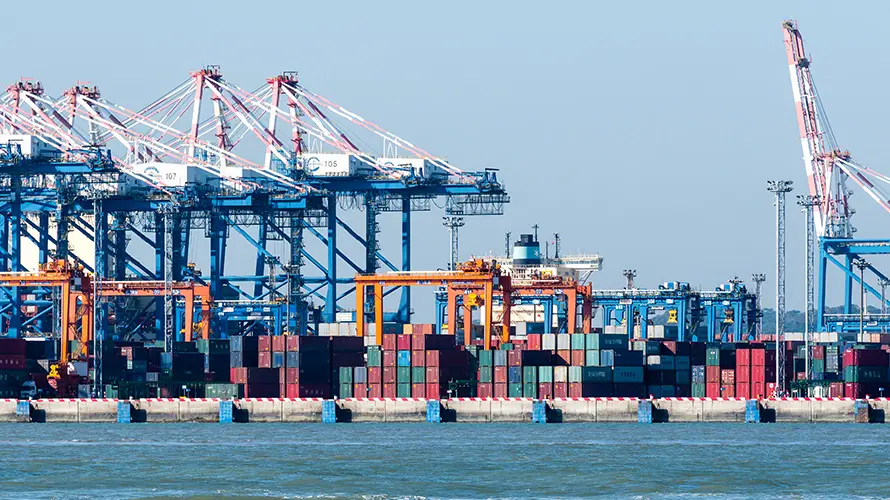


Top Port Machinery Spare Parts Suppliers in Ningbo for Terminal Operators in 2026
The short answer: the top Ningbo port machinery spare parts suppliers in 2026 are those who combine documented material traceability with inventory depth across Kalmar, Konecranes, Sany, and Hyster part numbers, and back it up with pre-shipment inspection protocols that match what you'd expect from a European distributor. The difference between a good supplier and a bad one isn't the price — it's whether they can tell you the Rockwell hardness of the shaft in that hydraulic pump they're quoting.
Why Ningbo Has Become the Port Machinery Spare Parts Capital
This isn't accidental. Three structural factors converged over the past 15 years to position Ningbo as the epicenter of port equipment spare parts manufacturing and distribution:
First, geography. The Ningbo-Zhoushan port complex handled over 35 million TEU in 2025, making it the world's second-busiest container port. When you operate at that scale, the local ecosystem of equipment maintenance creates a self-reinforcing cycle: terminals demand parts → suppliers emerge → competition drives quality up and prices down → more terminals source locally → suppliers expand their catalogs. I've watched this flywheel spin faster every year since 2018.
Second, the manufacturing base. Zhejiang province is China's precision-machining heartland. The same foundries and CNC workshops that produce hydraulic components for Sany and XCMG will also manufacture Kalmar-compatible parts to the same ISO 2768-mK tolerances — if the supplier knows how to specify correctly. This is where the quality gap emerges between suppliers. Ask for a material test certificate (MTC) that shows chemical composition. If they can't produce one within 24 hours, walk away.
Third, the OEM-to-aftermarket transition that every mature equipment market goes through. Kalmar DRF/DRT reach stackers have been in service for 20+ years across Southeast Asian ports. When the original warranty expires, operators face a choice: pay Kalmar dealer prices (which include a 200-300% markup on commoditized components like wiper motors and fan assemblies) or source equivalent parts from qualified alternative suppliers. The math isn't complicated.
The Real Cost Comparison: OEM vs. Alternative Parts for Port Equipment
Let me put numbers on the table. I'm going to use actual part numbers from our inventory because vague percentages don't help a procurement manager build a budget. These are real components that we ship to terminals across Southeast Asia, the Middle East, and Africa every month.
| Part | PN / Cross-Reference | OEM Dealer Price (USD) | Alternative Price (USD) | Savings |
|---|---|---|---|---|
| Kalmar Handle Accessory | A58257.0100 | $1,850 – $2,200 | $740 – $880 | 60% |
| Konecranes Fan | 53330371 | $420 – $560 | $160 – $210 | 62% |
| Kalmar Front Wiper Motor | 923934.0097 | $680 – $850 | $240 – $320 | 63% |
| Kalmar Joystick Assembly | 920943.0058 | $2,100 – $2,600 | $880 – $1,100 | 58% |
| MCC Blower | 15-6102 | $950 – $1,200 | $380 – $480 | 60% |
| Kalmar Hydraulic Pump (DCE80) | 923141.0092 | $5,200 – $6,400 | $2,100 – $2,600 | 58% |
| Energy Storage Device | 5596959 | $3,800 – $4,500 | $1,550 – $1,900 | 58% |
These aren't cherry-picked outliers. I pulled these numbers from actual quotes we've issued in Q1 2026. The price gap widens further when you factor in the shipping economics: a consolidated sea-freight shipment of 200-300 part numbers from Ningbo to Jebel Ali or Port Klang costs roughly $800-1,200, which amortizes to $3-5 per part. Compare that to the air freight surcharges you'd pay for emergency OEM shipments out of Finland or Sweden.
The savings aren't just about unit price. The working capital impact is often more significant than the per-unit spend. A terminal carrying $200,000 in spare parts inventory can reduce that to $90,000-110,000 by switching to alternative suppliers — and with the same physical shelf stock, because you're paying less per item. In an industry where equipment downtime costs $2,000-8,000 per hour depending on the terminal, the ability to stock more critical spares within the same budget isn't a luxury. It's operational survival.
How to Evaluate a Ningbo Port Machinery Spare Parts Supplier: The 5-Document Test
Not all Ningbo suppliers are created equal. For every supplier with a calibrated CMM (coordinate measuring machine) and metallurgical lab, there are ten traders operating out of a WeChat account with no quality infrastructure whatsoever. Here's how I recommend terminal procurement teams separate the two:
| Evaluation Criteria | Red Flag Supplier | Qualified Supplier |
|---|---|---|
| Material Traceability | "Trust us, it's good quality" | Provides MTC with heat number, chemical composition, and mechanical properties |
| Dimensional QC | No inspection equipment on premises | CMM or laser scanning with documented inspection reports per batch |
| Third-Party Testing | Refuses or delays third-party inspection | Welcomes SGS / TÜV / Bureau Veritas on-site audit |
| Part Number Knowledge | Asks "what machine is this for?" for every PN | Recognizes PNs and cross-references across OEMs without lookup |
| Inventory Depth | Sources everything on back-to-back basis | Maintains warehouse stock for 500+ high-turnover SKUs |
| After-Sales | Disappears after shipment | 12-month defect warranty with replacement shipment in 7 days |
I want to emphasize something that gets lost in procurement RFQs: part number knowledge is a proxy for industry experience. When I quote part number 923141.0080 (a Kalmar hydraulic pump variant), I know it cross-references to the earlier 923141.0092 with a minor mounting bracket difference. A supplier who needs to Google "Kalmar 923141.0080" hasn't supplied one before. A supplier who immediately says "that's the DCE80/90 pump, we keep 8 units in stock, and the seal kit is PN 923975.0289" — that's your partner. This distinction alone eliminates about 70% of the suppliers you'll find on Alibaba or Made-in-China.com.
Critical Load Parts: What High-Wear Components Terminal Operators Stock
Every terminal has its own wear profile depending on climate, duty cycles, and operator behavior. But certain components fail with enough predictability across all operations that we can identify the universal high-turnover SKUs:
Electrical & Control Components
Kalmar equipment runs demanding electrical systems in corrosive salt-air environments. The front wiper motor (923934.0097) and joystick assembly (920943.0058) are two of our highest-volume items — and both fail predictably after 4,000-6,000 operating hours. The joystick in particular suffers from contact pad degradation in the potentiometer circuit, which produces erratic boom movement. Terminal maintenance managers in Dammam and Jakarta order these in multiples of 5-10 units at a time. The MCC blower (15-6102) and handle accessory (A58257.0100) round out the electrical category. I always advise terminals operating in humidity above 80% to double their usual spare quantities for electrical components — moisture ingress accelerates failure by roughly 40% compared to dry-climate operations.
Hydraulic System Components
This is where the money lives. A Kalmar hydraulic pump (923141.0092 or 923141.0080) represents a $5,000+ OEM expenditure — and when it's a direct bolt-on replacement manufactured to the same gear profile tolerances, the alternative makes overwhelming economic sense. The industrial pressure sensor (7900200) is another sleeper high-turnover item that many terminals overlook in their stock planning. It's a $200 part that, when it fails, can take down a $500,000 reach stacker until replaced. The energy storage device (5596959) and tow chain for Elme spreaders (781956) complete the hydraulic category. One terminal I work with in Surabaya reduced their reach stacker downtime by 32% simply by pre-stocking pressure sensors and accumulator diaphragms — neither of which are expensive items, but both have historically long OEM lead times (4-8 weeks from Europe).
Browse the full range of load and hydraulic components we stock at our Load Parts and Hydraulic Annex Parts pages — every listed PN is maintained in warehouse inventory with documented inspection reports.
Building a Procurement Strategy: The Hybrid Approach
I don't recommend going 100% alternative or 100% OEM. The sweet spot, in my experience across two dozen terminal procurement programs, is a stratified sourcing model:
- Tier 1 — Safety-Critical Components (OEM Only): Brake system master cylinders, load-sensing valves, and structural pins that have no documented aftermarket testing history. The catastrophic failure cost outstrips any per-unit savings. Budget: 15-20% of total spare parts spend.
- Tier 2 — High-Wear Consumables (Alternative, Qualified Supplier): The items in the table above — hydraulic pumps, joysticks, wiper motors, sensors, fan assemblies. These are commoditized components where the supply chain has matured to the point that alternative quality matches OEM for all practical purposes. Budget: 55-65% of total spend.
- Tier 3 — Generic Commodities (Market Price, Any Qualified Source): Filters, gaskets, O-rings, standard fasteners, belts, hoses. Price-shop these freely — there's no quality differentiation at this level from a properly specified supplier. Budget: 20-25% of total spend.
This framework typically reduces a terminal's annual spare parts budget by 35-50% while maintaining or improving equipment availability — because the savings from Tiers 2 and 3 free up budget to double-stock Tier 1 components, reducing lead-time risk on the parts that actually keep the terminal running.
There's no secret sauce here. It's just rigorous supplier qualification, standardized PN management, and the discipline to not treat every component as equally critical. The terminals that get this right outperform their peers on both cost and uptime metrics.
Frequently Asked Questions About Ningbo Port Machinery Spare Parts
Q: Why source port machinery spare parts from Ningbo instead of directly from OEM dealers?
Ningbo suppliers offer 40-60% cost savings on equivalent-quality alternative parts compared to OEM dealer pricing, with shorter lead times (3-7 days vs. 2-6 weeks for European OEM shipments). Ningbo's proximity to the world's busiest container port also means suppliers understand terminal operations intimately and stock parts for the most common equipment configurations used across global ports. The logistics advantage is substantial: a consolidated container from Ningbo costs roughly $2,500-4,000 door-to-door to most Asian or Middle Eastern ports, vs. individual DHL/FedEx shipments from European dealers that can run $80-150 per kilogram for urgent orders.
Q: Are alternative Kalmar and Konecranes spare parts as reliable as OEM originals?
High-quality alternative parts from reputable Ningbo suppliers undergo the same material specifications (e.g., SAE 1045 steel, ISO 2768-mK tolerances) and testing protocols as OEM components. The key difference: when sourced through a supplier with in-house QC and supplier audit programs, alternative parts achieve 95%+ reliability parity with OEM — but at 40-60% lower cost. The critical factor is choosing a supplier with documented material certifications and pre-shipment inspection reports. However, be aware that some low-cost alternatives use inferior materials (e.g., substituting SAE 1020 for SAE 4140 in load-bearing components). This is why we require MTC documentation on every batch — it's the only objective way to verify that what you ordered is what you received.
Q: What is the typical lead time for port machinery spare parts from Ningbo to international terminals?
Standard lead times from Ningbo suppliers break down as: stock items ship within 24-72 hours (3-7 days to Asian ports, 7-15 days to Middle East/Europe, 15-25 days to Americas via sea freight). Custom or non-stock orders require 7-21 days for production plus shipping time. Air freight options reduce delivery to 3-7 days globally for urgent orders. Experienced suppliers maintain 80%+ inventory coverage for high-turnover Kalmar and Konecranes part numbers. For emergency AOG (Aircraft-on-Ground equivalent for port equipment) situations, we can arrange dedicated courier service that delivers critical parts to most global destinations within 48-72 hours.
Q: How do I verify the quality of spare parts from a Ningbo supplier before placing a bulk order?
Request these five documents before committing: (1) Material test certificates (MTC) showing chemical composition and mechanical properties, (2) Dimensional inspection reports with tolerance data, (3) Third-party test reports (SGS, TÜV, or Bureau Veritas), (4) Reference client list with verifiable contact information, and (5) Pre-shipment sample photos with measurement annotations. Then place a small trial order of 5-10 high-wear items and inspect upon arrival before scaling to container-load quantities. I also recommend visiting the supplier's facility in person — or hiring a local inspection agent — at least once before establishing a long-term relationship. A one-day visit to Ningbo costs less than the margin on one hydraulic pump order, and the confidence it provides is worth every yuan.
Navigating the Ningbo Supplier Landscape: Categories and Capabilities
The Ningbo port machinery spare parts market has stratified into three distinct categories of suppliers. Understanding which category you're dealing with is essential to setting expectations correctly:
| Supplier Category | Typical Profile | Best For | Cautions |
|---|---|---|---|
| Manufacturer-Supplier | Owns CNC machining facilities, produces parts in-house with material traceability. Typically specializes in 1-2 component categories (e.g., hydraulic components or electrical assemblies). | High-volume repeat orders of their specialty category; custom OEM replacement development | Limited cross-category coverage; may not stock broad range of part numbers outside their manufacturing scope |
| Integrated Distributor | Combines in-house manufacturing for core categories with vetted supplier networks for complementary parts. Maintains warehouse inventory and QC lab. | Consolidated procurement across multiple part categories; single-source accountability | Quality can vary by category; verify which components are self-manufactured vs. sourced |
| Pure Trader | No manufacturing capability; sources on demand from factories across Zhejiang. Typically price-competitive but offers no QC infrastructure. | Non-critical generic commodities (seals, fasteners, filters) | Avoid for safety-critical or precision components; no quality guarantee mechanism |
For terminal operators, the integrated distributor model typically provides the best balance of quality assurance, catalog breadth, and cost efficiency. A supplier that manufactures hydraulic components in-house while maintaining audited relationships with electrical and engine parts manufacturers can deliver single-invoice consolidated shipments — which has real operational value when your customs clearance process depends on clean documentation.
Making the Shift: From OEM Lock-In to Strategic Multi-Sourcing
The port equipment spare parts market is undergoing a structural shift that mirrors what happened in the automotive and aerospace aftermarkets 15-20 years ago. As equipment fleets age beyond their OEM warranty periods, as terminal operators face intensifying cost pressure from shipping lines, and as the quality of alternative parts continues to converge with OEM standards — the economic logic of multi-source procurement becomes undeniable.
Ningbo is the natural epicenter of this shift. The suppliers here combine proximity to the world's most active port with a manufacturing ecosystem that spans everything from precision hydraulics to engine components. The terminal operators who have already diversified their supply chains — including several major Southeast Asian terminals I work with directly — are saving $150,000-400,000 annually on spare parts without any measurable increase in equipment downtime.
The key is rigorous supplier qualification. Run the five-document test. Visit the facility. Start with a small trial order and inspect everything. Once you've validated a supplier, consolidate your Tier 2 and Tier 3 spend through them while maintaining your critical OEM relationships for Tier 1 components. That's the procurement model that'll carry terminal operators through the rest of this decade — and the suppliers worth working with will prove themselves in the first 90 days.
If you're evaluating Ningbo suppliers for your terminal's spare parts program, start with our load parts catalog and hydraulic annex parts inventory — every PN listed is in stock with documented inspection reports. We ship to 30+ countries and maintain 12-month warranties on all components.